
How Onyx Renewables halved design-to-PVsyst time by building the model once
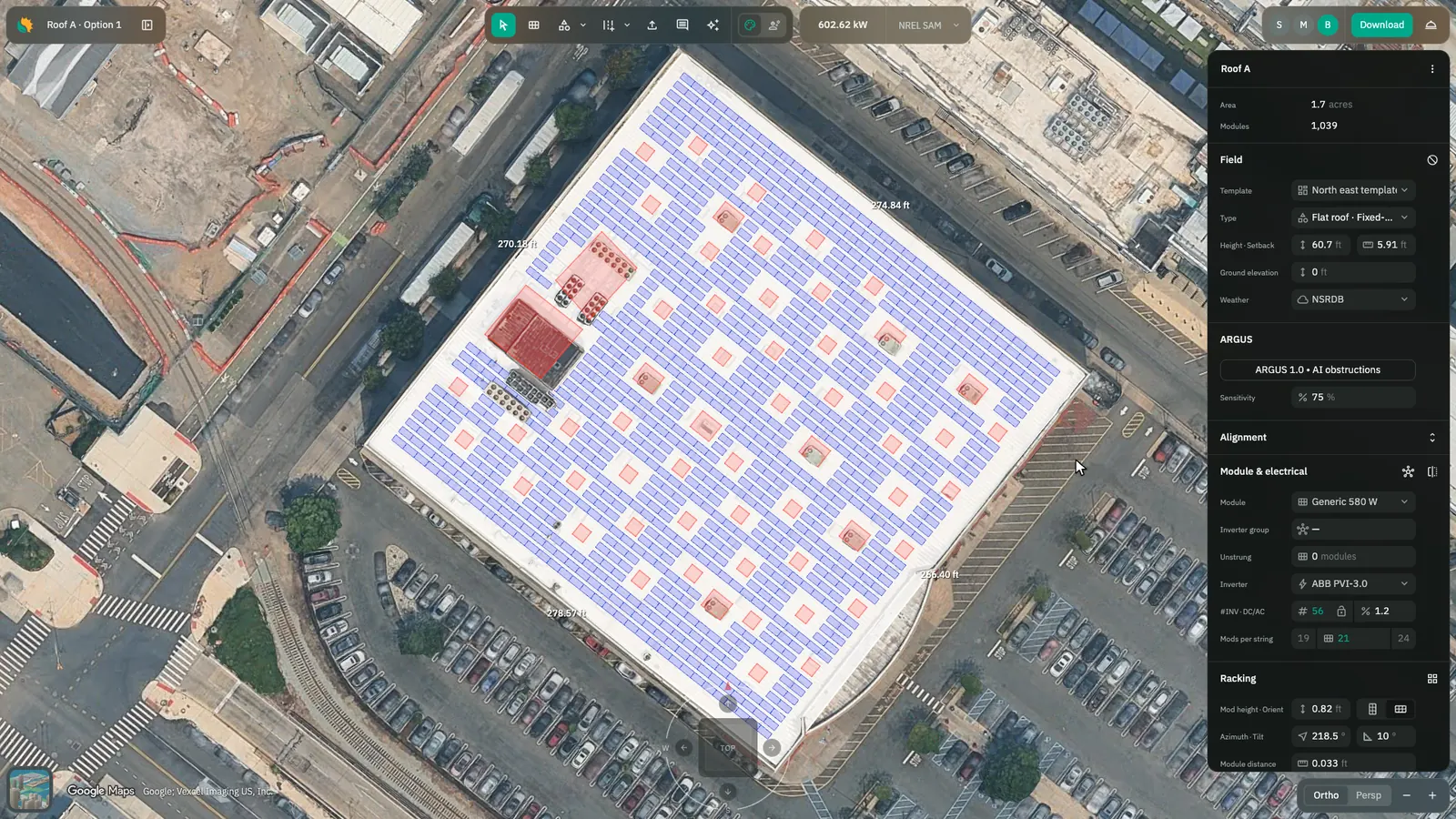
Onyx Renewables designs in Solesca and exports the shade scene natively to PVsyst, which removed the manual rebuild that used to sit between the two tools. A full production estimate now takes one to two hours instead of two to four. PVsyst calculates electrical losses against the real module layout rather than an approximation of it, so early-stage energy estimates moved from indicative to definitive.
50%
Less design-to-PVsyst time
1–2 hours
Per production estimate, down from 2–4
Zero
External layout requests outsourced during RFPs
Share This




About Onyx Renewables
Four engineers carry that entire load, owning the full project lifecycle: preliminary design, initial diligence, construction and final completion. There is no separate modeling group. Whatever the design workflow costs in hours, it costs the same four people. That is why design accuracy at the front of a project matters more here than at a developer who sells the asset on.
| Detail | Onyx Renewables |
|---|---|
| Industry | Onsite clean energy for commercial and industrial businesses |
| Portfolio | 400+ projects in operation; 11+ GW of development experience |
| Project types | Carport, roof-mount, ground-mount and tracker systems, plus solar and storage |
| Engineering team | Four engineers, led by the VP of Engineering |
| Solesca use | Preliminary layouts through construction-stage design, with PVC export to PVsyst |
The workflow, before and after
| Step | Before Solesca | With Solesca |
|---|---|---|
| Design the system | In a preliminary design tool | In Solesca, about 30 minutes |
| Confirm diligence | Public software and databases: hosting capacity, wetlands, aerial imagery | Wetland layers generated in place of manual USFWS screenshots |
| Rebuild the shade scene | Recreate the design inside PVsyst by hand | Removed. The native PVC export carries the design across |
| Model production | In PVsyst, on approximated geometry | In PVsyst, on the real module layout, about 30 minutes |
| Total | 2–4 hours per project | 1–2 hours per project |
The challenge
1. Building the same shade scene twice
“Redoing the shade scene and layout of the array, especially for rooftop systems, was a clear pain point for the team and a source of redundancy.”
– Onyx Renewables engineering team
2. Estimates that stayed indicative
Rebuilding the geometry inside PVsyst introduced its own ceiling. PVsyst provides robust shading analysis, but Onyx found that generating detailed rooftop shade scenes, particularly for complex subarray configurations and bifacial modeling, proved challenging. Rooftop systems were the hardest hit, and rooftop is where much of the C&I portfolio lives.
Why Onyx chose Solesca
- Price
- Efficiency of design
- Ease of use: flexibility in design and a seamless user experience
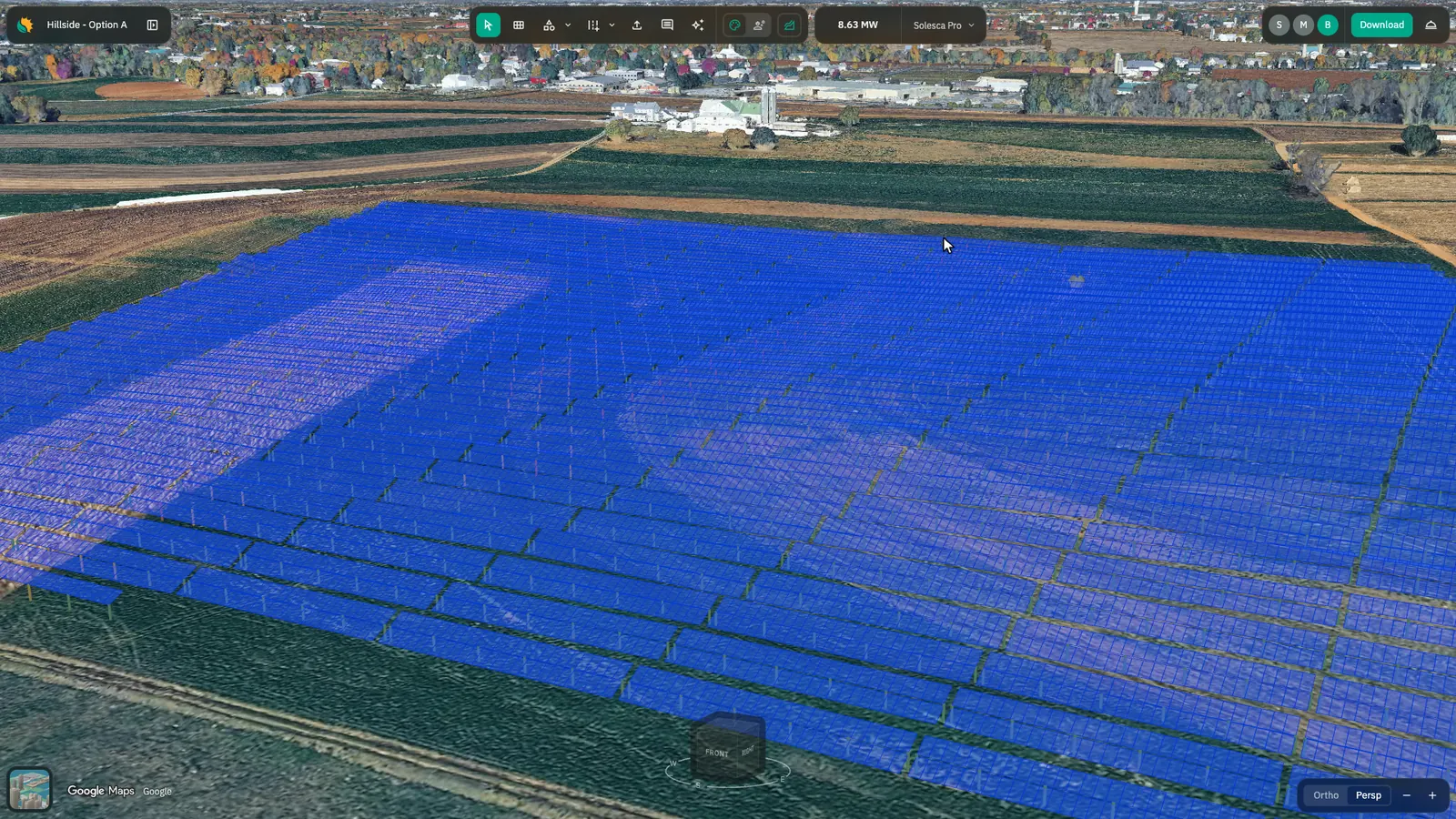
“The integrations with PVsyst and PVC exports have been a game-changer for our team’s workflow, and it seems like new helpful features are released very frequently.”
– Onyx Renewables engineering team
The results
1. Half the time to a PVsyst-ready model
2. One model, accurate at the module level
“Using Solesca has greatly reduced the redundancies in our engineering design workflows and has improved our confidence in our production estimates throughout the project lifecycle.”
– Onyx Renewables engineering team
3. Capacity without adding headcount
“Without Solesca in our workflow, we would spend less time completing higher-value tasks for our organization. Previously, the Engineering team had considered supplementing capacity to accommodate our workload, especially when design requests for large RFPs were opened.”
– Onyx Renewables engineering team
4. A faster handoff to Originations
5. A design that stays in the project
Final thoughts
Moving tools also came with friction. Onyx reports struggles around differences in the interface and design features during onboarding. What made the move work was the response on the other side. Solesca stayed responsive to questions and to feature requests throughout onboarding, and Onyx credits the openness of the working relationship: collaborating with the team, sharing future plans, and being transparent about decision-making on feature implementation.
“Working with the Solesca team has been great. They are a smart team that has brought some much-needed high-quality competition to the solar design software space. I really appreciate their responsiveness, not just for quick issues but for questions on their methodology. The software is very easy to pick up, and I appreciate the constant updates the team is working on behind the scenes!”
– Onyx Renewables engineering team
Improve accuracy, reduce rework, and streamline project evaluation with Solesca.
Book a 30-minute demo with our U.S.-based engineering team. No CAD setup required.