Energy model
A yield number the doubter can re-run.
Simulations validated against PVsyst, DNV SolarFarmer inside the tool, and export to PVsyst, CAD and 8760, so the person who doubts your number can re-run it rather than argue about it.
Trusted by leaders in solar development










What the energy model gets back
A number close to the one they trust
Solesca simulations validate within 1% of PVsyst, and the comparison is reproducible by anyone with the export.
A handoff that is a file
Solesca works upstream of PVsyst and exports to it natively, so the simulation of record is not rebuilt by hand.
Output the next model can use
8760 export gives the hourly series a storage sizing exercise or a financial model needs downstream.
If your yield number has to survive someone else
Your production figure goes in front of a customer, a committee or a reviewer, and it is only worth what it survives there.
What Solesca takes off the list
- The benchmark you ran on yourself
- A counterparty weighs names they already recognize differently from a comparison nobody else can repeat.
- Validation
- The shade scene rebuilt by hand
- Without a native export, every design is reconstructed inside PVsyst, and early estimates stay indicative.
- PVsyst handoff
- The flat derate
- Wire losses applied as a number somebody chose once, instead of calculated from the wiring.
- What the model carries
Validation
Show who else checked the number
A formal methodology publication is not yet posted, and we say so. What is public is named and repeatable.
- Customer and lab
- ECA Power’s published case study, and a cooperative research agreement with NREL, CRADA CRD-23-23746
- Engine partner
- DNV SolarFarmer runs inside Solesca through DNV’s API Partner Program
- Regulator
- A California Energy Commission staff review, August 2025, recommending the Solesca tool for certification under the 2022 Energy Code
PVsyst handoff
Hand PVsyst a file, not a rebuild
Plenty of teams keep PVsyst as the simulation of record for financing. The native export makes the handoff a file.
- Solesca works upstream of PVsyst and does not try to replace it
- The PVC export lets anyone rebuild a Solesca design in PVsyst and check the agreement themselves
- At Onyx Renewables, removing the rebuild took a full production estimate from two-to-four hours down to one-to-two
What the model carries
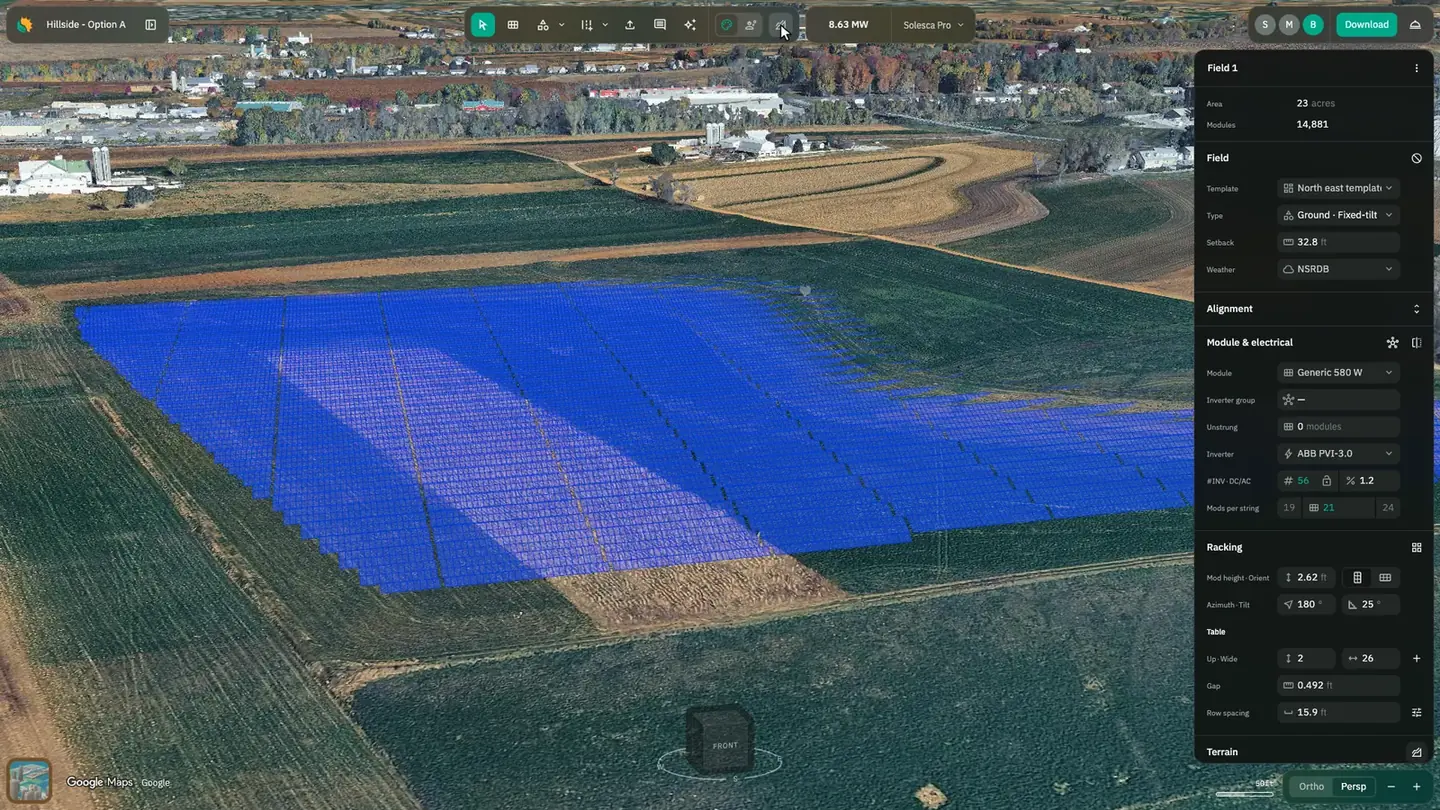
Model the array as it will be wired
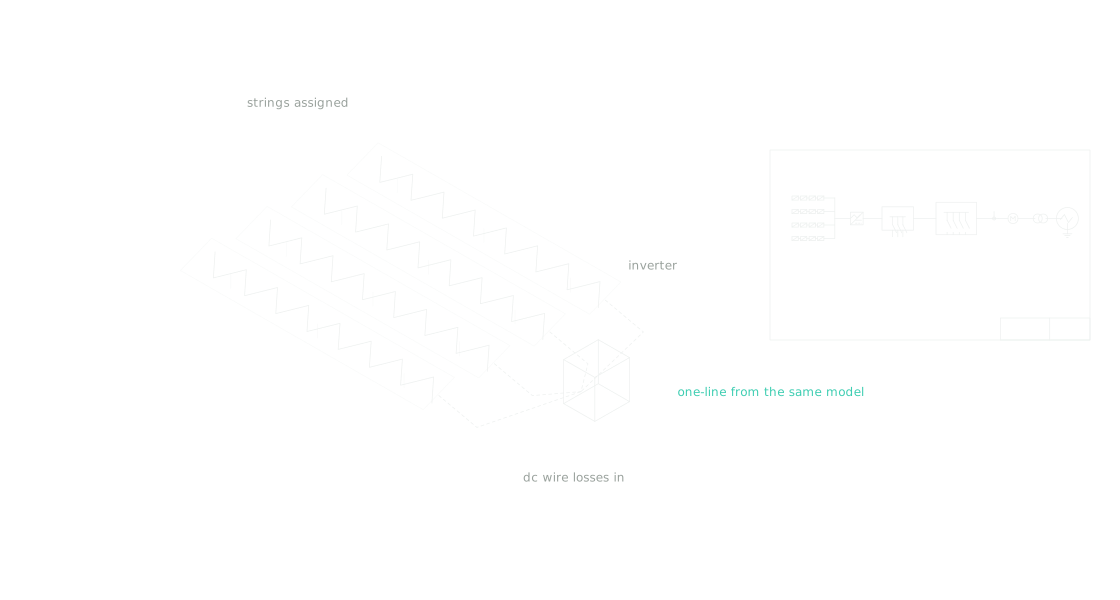
The yield is computed on the array as designed, including the conductor run you intend to install.
- DC stringing carries its wire losses into the production figure
- Unlimited DNV SolarFarmer simulation on the Engineering License, in the same workflow
- PVsyst, CAD and 8760 export, and the API on the Design License
Who already runs it this way
Using Solesca has greatly reduced the redundancies in our engineering design workflows and has improved our confidence in our production estimates throughout the project lifecycle.
How it runs, from layout to a number you can defend
- 01
Design
Lay out and string the array, with wire losses in the model.
- 02
Simulate
Run the yield in Solesca, or DNV SolarFarmer on the Engineering License.
- 03
Compare
Export to PVsyst and check the agreement on your own design.
- 04
Hand off
Send the 8760 series to storage sizing or the financial model.
The detail, if you want it.
The long answers, for the reader who wants them.
How accurate are Solesca simulations, and who says so?
Solesca simulations validate within 1% of PVsyst. The public corroboration is ECA Power’s published case study, together with Solesca’s cooperative research agreement with NREL, CRADA CRD-23-23746, and the DNV SolarFarmer partnership. A formal methodology publication is not yet posted, and it is worth saying that rather than implying a study that does not exist.
The comparison is reproducible either way, which matters more than a certificate would. The PVC export lets anyone rebuild a Solesca design in PVsyst and check the agreement themselves.
Does Solesca replace PVsyst?
No, and it is not trying to. Solesca works upstream of PVsyst and exports to it natively. Plenty of teams keep PVsyst as the simulation of record for financing, and the point of the native export is that the handoff becomes a file rather than a rebuild.
Onyx Renewables is the measured version of this. Their previous tool had no PVC export, so every shade scene was rebuilt by hand inside PVsyst — which left stringing losses unmodelled and made early estimates indicative rather than definitive. Removing the rebuild took a full production estimate from two-to-four hours down to one-to-two.
What does the model account for?
The array as designed, including the wiring. DC stringing carries its wire losses into the yield, so the production figure reflects the conductor run you intend to install rather than a flat derate somebody set once. On the Engineering License, DNV SolarFarmer simulation is unlimited, so a team that reports SolarFarmer results can produce them in the same workflow.
The output is not only a headline figure: 8760 export gives you the hourly series, which is what an energy model has to hand to a storage sizing exercise or a financial model to be of any use downstream.
Is the tool recognized outside the industry press?
The California Energy Commission published a staff certification review at energy.ca.gov in August 2025 recommending the Solesca tool for certification under the 2022 Energy Code. That is a regulator’s staff review rather than a marketing award, which is the reason it is worth citing at all.
Beside it sit the NREL cooperative research agreement and the DNV SolarFarmer partnership. Three names a counterparty already recognizes is a different conversation from a benchmark you ran on yourself.
Can I get hourly output?
Yes. Designs export to 8760, PVsyst and CAD, and the API is included on the Design License.
What role does DNV SolarFarmer play?
DNV SolarFarmer runs inside Solesca through DNV’s API Partner Program. The Engineering License includes unlimited SolarFarmer simulation.
Re-run a project you already modeled elsewhere
The only benchmark that settles this is your own. Bring a design whose yield you already trust, rebuild it in Solesca, and export it back to PVsyst to see how far apart they land. Thirty minutes with our U.S.-based engineering team.